Tuesday, 18 February 2014

The story of Ali Saleem Mousa

Ali Saleem Mousa
Ali Saleem Mousa has a large family - his children and grandchildren number 32. He lives with all his family on the western fringe of the village of Al Khader, about 5km west of Bethlehem.  He owns and farms 30 hectares of land. 

The Annexation Wall has been built through his land, which is in the West Bank. It has been classified as area C under the Oslo Accord, which means that no buildings are permitted by Israel without a permit; no permits have been granted for buildings in Al Khader since 1967. 


Ali Saleem Mousa's house
Ali Saleem Mousa has received 6 demolition orders and his house has been demolished three times so far. Yet he shows incredible resilience and resistance to pressure from the Israelis to vacate his land. 


The view from the house
Part of his land can be seen from the house, but is now behind the wall. Instead of a 10 minute walk, he now has to travel 1 hour on a donkey - he is not allowed to take a vehicle - to tend his crops. 

Ali Saleem Mousa can recite the names of 11 generations of his family. All have lived on this land. He lived in the small shack you can see in the photo for 25 years. As his family started to grow, he build a new house. He lives without an electricity or water supply - he has to buy water from a tanker at £50 a time which lasts the family 4 days. 

As the house is high on a hill overlooking Al Khader, the Israelis used the land next to the house to build a military camp, from which they could fire on Al Khader during the 2nd Intafada in 1999/2000. 

The route of the Annexation Wall was planned to pass through the property and so in 2002, the Israelis arrested all the family and took them into the military camp while they demolished the house. 

Ali Saleem Mousa started building again.  Two months after the house was complete, he received another demolition order. He fought this in the courts and got the demolition stopped.

In 2004 the Israelis came and demolished the new house, and two more of his houses as well. 
The Anexation Wall, gate and tower
The Annexation Wall was completed in 2006; it is about 150 yards in front of the house. When the wall was completed in 2006, the military camp was closed and replaced by a watch tower in the wall overlooking the property. A huge metal gate in the wall allows the Israeli military to enter Al Khader whenever they choose.

In 2010 the bulldozers came again, despite the fact that Ali Mousa had a court decision from the Israeli High Court declaring that the demolition was illegal. The soldiers took no notice and demolished the house. 

After this third demolition, the Mayor and other  dignitaries came - the Housing Minister, the Governor, Leader of the Palestinian Authority - and pledged their support for Ali Mousa. 


We listen to Ali's story
He began rebuilding for the third time. He bought materials for the house, confident in the knowledge that the municipality would help him. They didn’t and he went to prison for not paying the bills. During the rebuilding, the Israelis came several times and and took away materials that he was using to build the house.  He got all his friends to dump stone and earth on the road to block the route from the large gate in the wall through which the Israelis enter his land. 

In September 2012 he received another demolition order. 

Ali Saleem Mousa told us today “I do not cry for my house, I cry for my land. I am ready to pay my life for my land.”


Some of the family, and the donkey
This battle has so far cost this family £60,000 in legal and rebuilding costs. He also gets a bill each time from the Israelis for the cost of demolishing his house. 

The Israeli Government plans to extend the Annexation Wall in both directions. If this is done, he will have no access to his  land. 

Do you think Ali Saleem Mousa is a security threat to Israel?

Busy day - lots of stories


I spent the day with Marwan from the Holy Land Trust. We had such an amazing day in Al Khader. First of all we met with the Deputy Mayor and then travelled around hearing stories. We visited three families and the High School. I am going to write about two of the families.

Ali Saleem Mousa has had his house demolished three times. 

The Sbieh family were about to move into their new house when the soldiers turned up and demolished it.  

See their full stories above.

An opportunity for reflection

Sea of Galilee near where Jesus preached the Sermon on the mount
I am being picked up by car this morning at 9:30am, so I have a little more time to myself. The family are all out at school and work, so it is quiet. I have been reading Tom Wright's book on "Luke for Everyone" and can recommend it.

Today I have reached the Beatitudes, where Jesus blesses:-
- the poor
- the hungry
- those who weep
- those who are hated

The Palestinians seem to me to be eligible for the most blessings, since they fall into all these categories! It brings home to me why I feel called to be here, to join others in showing the Palestinians that God loves them and that people care about them. We need God's kingdom to come urgently for these people. 

It makes me sad that in this place, with Jews, Muslims and Christians all worshipping the same God, we have not been able to find a Godly solution. We even have a holy day shift system, with Muslims on Fridays, Jews on Saturdays and Christians on Sundays. Still needs more prayer though. 

Please pray today for peace and justice for everyone in Israel/Palestine.

Monday, 17 February 2014

Planning the week and tea with Odette


Today I was back in the Holy Land Trust. I spent the morning writing an information note which might be provided as advice to potential UK visitors to Palestine. I also had the opportunity to have a chat with Antwan, the general manager at HLT. I enjoy times in the office as well as out in the field. We all had lunch together.

Then we planned the week. Tomorrow I am out in the field with Marwan, so another story to write I expect. On Wednesday I am going to the Tent of Nations which will be interesting I am sure. More about that on Wednesday.

I have written to a couple of organisations with a view to visiting, so hope to have some stories from those.

On Saturday Ayed, my host, is taking a group of us for a drive in a 4x4 in the desert - looking forward to that.

At four o'clock I left the office have tea with Odette. This is a charming lady that I met on Sunday. We discovered that she lives close to the HLT office and so she kindly invited me to join her for tea. We had a lovely chat and I gave her some help in sorting out her computer. 

She invited me to join her at a concert on Saturday, so am looking forward to that.

Lots to look forward to this week. 

Sunday, 16 February 2014

Article from Ma'an News dated 11th Feb

Click here to see the article "Camp on front line of struggle against occupation". I live 100 yards from here.

A sad start to the day

I chose the take the no 21 bus into Jerusalem today. This is an easier route and one that does not involve going through the turnstile and scanner on foot at Checkpoint 300. No 21 is used mostly by Internationals and people with blue IDs (i.e. Jerusalem residency). There is a checkpoint and someone boards the bus, but it is not intrusive.

I had just boarded the bus and it was about to leave when I noticed a young lad of about 11 with a very young puppy. It was not on a lead and it ran into the road. The bus moved off and ran over the little puppy. I saw the boys face as he screamed and then cried. It broke my heart. I suppose in the scale of things here it was not significant in terms of the brutality shown to people. But I feel for the young people growing up traumatised. How can they learn to love their neighbour when their lives are so controlled. 

So I was very sad as I walked through East Jerusalem. This week I went to the East Jerusalem Baptist Church, where Alex Awad (Sami's uncle) is the pastor. Sami's dad was also there - he founded Bethlehem Bible College. I got a very warm welcome and enjoyed the service. 

Alex Awad had just returned from a trip to Jordan where he had been working with other Palestinians from the Bethlehem Bible College helping the refugees from Syria. It is good that, even with the problems here, the Palestinian Christians are still committed to showing God's love to others.

There were lots of visitors and we all introduced ourselves. Some of the American Students I met in my first week were there. The small Church was packed with about 50 people. I had coffee and enjoyed chatting with several people after the service. 

I met the couple who operate the Garden Tomb, which we visited while on our Pilgrimage last year-the husband was a pupil at Wellington College. Also met Odette, who lives in Bethlehem and used to work for the UN. I have been invited to tea tomorrow! I had a nice chat with Beverley who teaches English at the Bethlehem Bible  College and have an invite to go there too. Quite a sociable morning. 

Then back on the bus to Bethlehem. 


Saturday, 15 February 2014

Feeling foolish

Spent some time researching options for going to Church while I am here. Apart from the Church of the Nativity, which is Greek Orthodox, I could not find any on the web. This seemed strange, especially when I read that Beit Sala, one of the cities within Greater Bethlehem, and close to where I am living,  has 70% christian population. 

So I walked to Beit Sala, which I discovered was on the next mountain! To my surprise, I found lots of Churches and they were beautiful, for example, the Church of the Annunciation, St Mary's Church, the Lutheran Church and the Church of St Nicholas. 

The picture is of the Lutheran Church. The reason that I could not find anything on the web is that all the services in all these Churches are in Arabic - I know now that I should have realised that. Hence there is nothing about them in English on the web. I called there and they told me that if I came, they would translate part of the service into English - cannot imagine translating our service into Arabic for a Palestinian calling at St Johns!

The only English service I have found so far is in Jerusalem, so I will go there again tomorrow. I am going to do some more research next week to find out whether there are English services in Bethlehem. 

Friday, 14 February 2014

A walk to Solomon's Pools

Today my family has a rest day. I decided to take a walk to Solomon's Pools. These are three absolutely massive reservoirs that supplied water to Bethlehem and Jerusalem. They date from Herod's time rather than Solomon, but that still makes them 2000 years old. They hold 200 million litres. 
After about an hour walking south from Bethlehem centre, I came out into open countryside. The mound on the left of the horizon is Heridian, King Herod's summer palace. It was very warm walking, so I was grateful for the barber who invited me to come and sit down and share a coffee with him.
I walked down the steep valley through Artas, one of the oldest towns in Palestine, dating from the iron age. This is also the site of the really beautiful Convent - Hortus Conclusus. 
At this point I had no idea which way to go. The people of Artas do not generally speak English and no-one could understand me. Just as I was starting to worry, a nun appeared. She gave me precise directions and I was so grateful. Someone always appears to help me when I need it. 

After a very steep climb I arrived at these incredible cisterns. I was fairly exhausted, but was called over by a family on an outing from Hebron who were having a bar-b-cue. They immediately found me a chair(!) and something to drink. Then they brought over the local equivalent of a hamburger. I had brought lots of things for me lunch and yet again people feed me. I had to have my picture taken with all the children. 

Unfortunately, the occupation is never far away. On this hill overlooking Artas is fence, and some pylons. What happens is that a few Israeli settlers make a temporary encampment on a hill. Then the temporary encampment is provided with small housing units. Next the water and electricity comes, and the encampment is surrounded by a fence. A new road is build and then the temporary housing units are systematically replaced by new houses and you have a settlement - on Palestinian land. Meanwhile only 3kms of the 12kms of roads in Artas have been paved. 

It is puzzling that the israelis keep complaining about Palestinian attacks on the settlements, but they still keep building them closer and closer to the Palestinians. Seems that they would be much safer in their own country.

Alongside this (once popular and now deserted) tourist attraction is a beautiful new congress centre. I felt a sense of pride for the Palestinians in building this magnificent centre. And when I got home I read the following:-


"Rarely does a night go by without the sounds of the Israeli army’s shells and rockets shattering the peacefulness of the once tranquil and serene village of al-Khader, where Solomon’s Pools are. The Pools are located at the southern edge of Bethlehem in Area A, which is under the control of the Palestinian National Authority. A major Palestinian historical site in Bethlehem, and one of the most unique and attractive locations in the whole of the Palestinian territories, the Israeli army has kept the Pools under fire since January 2001 causing a great damage to the historical site as well as to the new Convention Center and the Crafts Center that are part of an ambitious project designed to attract new types of tourism, i.e. conference tourism. "

I felt foolish because I had just walked through the site without realising the family having a picnic were such a threat to the Israelis. 

Thursday, 13 February 2014

Met Sami Awad

Had lunch and a good talk with Sami Awad, the CEO of Holy Land Trust. Enjoyed talking to him.

Washing Day

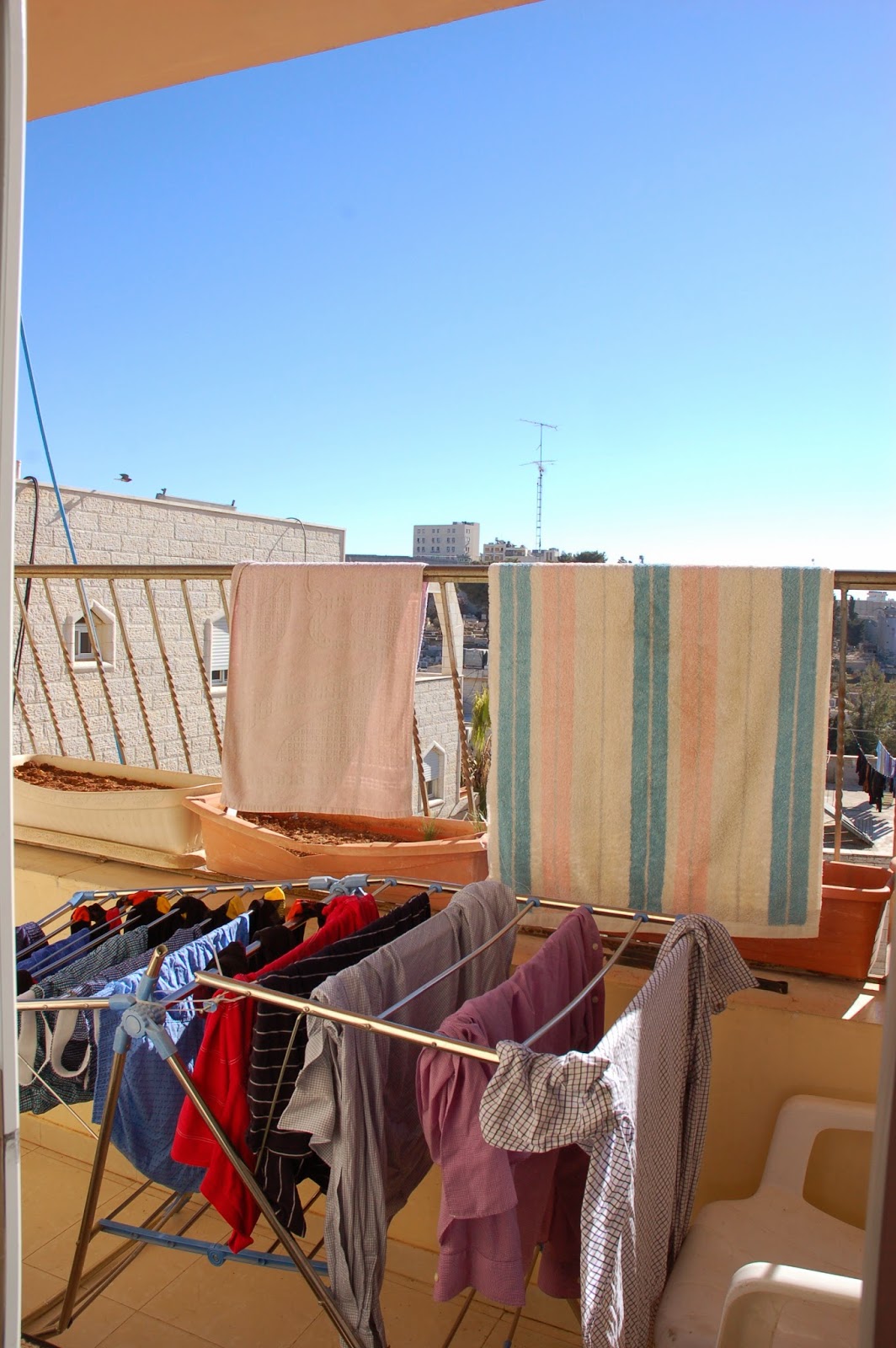
Today the water is on and so Ayed tells me it is a good day for washing. I washed my clothes - Tracy will be delighted that I have learned a new skill. See the cloudless sky. It is really warm. I am thinking about the UK - people here would love some rain, if you have any to spare. Arrived in the office at 10am, just in time for second breakfast - am getting used to life here!

Note that the towel hides the view of the tower. Last night Ayed told us that it was from this tower that an Israeli soldier sniper shot Ayed's nephew. The bullet passed straight through his trunk and he survived. The children were playing with toy guns on the balcony. We are never far from a story here.

Wednesday, 12 February 2014

The Holy Land Trust

I thought that you might like to see what the Holy Land Trust looks like. Let's start with the most important part - the people. From the left - Marwan, Dima, Rana, Elias, Osama and Rafat. We usually share lunch together here. 
The building before renovation
The Holy Land Trust moved to a renovated two-thousand year-old building in the heart of Bethlehem’s Old City, in May 2012. The building’s five floors provide ample space for the continuation and growth of HLT’s projects, beginning with the development of a Peace Research and Learning Center (PRLC) to create a Bethlehem-based gathering place for global research, publications and learning on issues of peace, nonviolence, conflict resolution, transformation and healing. Scholars, experts, and peace studies students from within the community and from around the world will bridge theory with practice in one of the world’s most volatile and complex conflicts.

This is where I hang out, usually at the desk on the right of the picture. 
How is this for a rooftop view. We are only a few minutes from Manger Square and the Church of the Nativity.  

Water, water everywhere and not a drop to drink


One of the rather strange things here is that you can always tell, whether in Israel  or the West Bank whether a house belongs to a Palestinian family or an Jewish family. Around 20% of the population in Israel is Palestinian so this is not a territorial thing, it is an ethnic phenomenon. Israel takes 90% of the available water in Israel and the West Bank for Jewish families. Palestinian families,wherever they live have to survive on the remaining 10%. While Israeli houses have unlimited supplies, Palestinian families have less than the WHO's minimum standard. 

Hence every Palestinian home has one or more black water tanks on the roof. In the picture above you can see the black tank on the house in the foreground. The houses in the background are Jewish. 

What makes this worse is that the Annexation wall snakes around the main aquifers in the West Bank to enable Israel to control them. Of course, this is a violation of International Law, but others countries seem not to care enough to make Israel stop stealing water.

This was brought home to me when Ayed my host told me yesterday that this house gets water one day every fortnight! Each suburb of Bethlehem gets water like people in the UK get rubbish collection. Ayed checks every day if the "mains" water is on, and when it is, he pumps the water up to 6 large tanks in the room. For the rest of the time we use the stored water. In the height of the summer, there is even less and Ayed has to buy water from a water tanker. The water is also sometimes switched off by the Israelis for security purposes. If the security issue affects a single house, a soldier may just shoot a hole in the black tank!

So just remember that when you leave the tap running to clean your teeth and turn off the tap to remember people who depend on others for their water. 

The title courtesy of the "The Rime of the Ancient Mariner" by Samuel Taylor Coleridge.

Tuesday, 11 February 2014

... and family number 2

In 2005, Waled and his wife Abeer were happily living in their home in Wadrahal, within the district of Bethlehem, where their families had lived for generations. Abeer was expecting their first baby, due in a few weeks. 


Then a letter arrived to say that the Israeli Military had deemed the house a security threat and would be demolished. Waled needed to go to the court in Ramallah on the following Thursday if he wished to challenge this order. Waled was on his way to Ramallah when the bulldozer arrived and destroyed his house and the one next door - shown in the picture.

Abeer was at home alone and was so traumatised by the experience that she lost her baby. The family were forced to live in a tent among the ruins for 5 months. Then Abeer's sister offered them one room of her two roomed house. 


The Holy Land Trust decided to rebuild the house. In 2008, they organised international volunteers to pay a share of the cost and to come and work on the rebuilding. It took 45 days to build the new house. 


Since then Abeer has had two delightful twins - Fatima is in the picture with her mum. 

However, life is still complicated. Waled has a job in Jerusalem and so has a permit to travel into the city each day. Unfortunately, being Palestinian, he has to travel into Bethlehem and queue at the checkpoint. He leaves at 3am every day to join the queue of thousands who wait for the checkpoint to be opened. He gets back home between 8 and 9. 


In 2005, the nearest Israeli houses were over 2 kilometres away. Now the new settlement of Efrata can be seen just a few hundred yards in front of Waled and Abeer's house. A new road from the Efrata settlement gets the people living there into Jerusalem in about 20 minutes using special roads and tunnels available to Israelis only. 

The annexation wall will soon be extended and pass in front of the homes in this village, thus taking more land into Israel and making it more difficult to get around Palestine. 


An emotional day


I visited two families today. This is the story of the first family, the Hejazy's.

Salim Hejazy and his wife Neama live with their seven children in Thabra, a small community in the hill country south of Bethlehem, between Bethlehem and Hebron. The family has lived in a tiny single shack for the past 25 years.


In 2002, their son, Amer, at the age of 5, developed a fever and needed urgent medical attention. Neama carried him all the way to Bethlehem, a distance of 8-10 kilometres. 

Unfortunately the 2nd intifada was at its height and Israel had in progress, and closed down all the Palestinian towns and cities, including Bethlehem. She was not permitted to enter by the Israeli military, so she carried Amer all the way back home. In desperation, even though it was even further, she decided to set off carrying him to Hebron. But the army had also closed roads around Hebron and threatened to shoot her if she tried to continue. She had to return home. Soon after Amer had an aneurism, which left him severely brain damaged. Now, at the age of 17, he really needs special care, but the family cannot afford this. Amer can only eat special food, which costs 66 Shekels per day – about 2/3 of the amount that Salim earns working at the local quarry.


The shack has a single cold water tap and is in very poor condition. The ceiling in one of the rooms is collapsing, as the roof is weak. It is not suitable for 9 people, especially when one of them is severely disabled.

The Holy Land Trust has decided to provide some dignity to this lovely family by providing them with a home which is suitable for their needs. Work started in 2011 and has now reached the stage where the external structure is finished. Around 15,000$ is still needed to complete the work.

The hospitality of this family was humbling. We were provided with tea and coffee and freshly baked kras - pastry filled with spinach, onions and herbs. I could barely hide my tears for this wonderful family. 

And then went on to hear another story...

Palestinian Hospitality

One of the villagers at the house key ceremony yesterday invited us to tea. She had been the neighbour of Wafaa before the family moved. The hospitality of the people here is overwhelming. 

I am off out again today with Marwan, the field coordinator, who oversees the work of the Holy Land Trust in 19 villages around Bethlehem. He knows everyone and every day is an adventure travelling with him. 

Lots of tears of happiness yesterday

Yesterday's blog told the story but not the emotion of the day. This photo shows Wafaa and Abed, with their four boys, proudly welcoming everyone to their new home. In the morning I had watched a video of her talking in front of the pile of rubble that had been their new home in 2002, just complete one month earlier. Marwan from the Holy Land Trust, in the centre, works with such families to rebuild community and hope. The villagers turned out in force and shared the joy. There was not a dry eye anywhere. This incredibly beautiful village is 2000 years old and the people still work traditionally. It is a fertile valley, irrigated by ancient irrigation systems fed by strings. There is an Israeli proposal to extend the separation wall through the village - it is being fought in the courts now. That would take 40% of the land of the these people. They would look out on their windows not onto beautiful peaceful hillsides but at a 24 foot wall built within yards of the houses. Can this be just? We can only be happy that there is joy today and to see what tomorrow brings.  

Monday, 10 February 2014

Building houses - building hope

Today there was a huge celebration in Battir. A house has been finished. Wafaa and Abed have moved in with Abed’s mother and their four children.

How can this be news. Surely this happens every day you are saying.

What happened today does not happen every day. Now read the story and feel the joy.

Wafaa and Abed’s family have lived for many generations in the beautiful and peaceful village of Battir. The fertile lands around the village are filled with vegetables, fruit crops and olive groves, watered by ancient irrigation systems, built more than 2000 years ago. The family was growing and so they started to build a new house on their land in the hills surrounding the village. It took them four years and was finished in 2002.

Just one month after they moved in, the Israeli soldiers descended without warning on the village, closed the roads, and brought in bulldozers. With no court order, no warning, and while the family were out, they moved in a demolished this home, with all the family belongings inside.

Those who live in a just world will seek to find a justification for such action. Battir is close to the Green Line, the boundary established between Israel and Palestine in 1967. The villagers are perceived by Israel as a security threat, particularly as the nearby Jewish settlement grows ever larger and nearer to the village.

Can you imagine the distress caused to the family. Wafaa did not visit the site for 10 years as the pain was too great – she has since apologised to the house. Many officials came to visit and to talk to the family, but nothing was done.

Then The Holy Land Trust told Wafaa and Abed that they would work with others to rebuild the house. The work started in 2012. The word spread and others came to help, including the Amos Trust, based in the UK.

And today the keys were handed over to Wafaa and Abed and they have moved in. For today at least, everyone can celebrate and share the joy. 

Sunday, 9 February 2014

Going through the checkpoint

In order to leave Bethlehem to go to Jerusalem, I have two choices. Internationals can use a bus that starts from Beit Jala and goes straight to Jerusalem. Palestinians have to walk through the checkpoint to catch the no 24 on the Jerusalem side. 

I chose to go through the checkpoint and found it a traumatic experience. It is difficult to describe in detail, but I felt totally humiliated by the process. I knew that, as an international, I would be permitted to go through, but I was still very nervous - I saw others who were taken aside and subjected to "thorough" searching. How people on both sides of the process can do this every day, I cannot begin to understand. Not only that, but I went after all the workers and they start queuing at 4am. Needless to say, photos are prohibited. Not surprised.

Of course, once through, I had a lovely morning. I went to Church at St George's Cathedral and the service was really uplifting. I met Naim Ateek and Hanni, our guide from the Pilgrimage with the Bishop last year. I spoke to lots of people and joined some of them to stroll through the old city before catching the bus back. Fortunately, going back into Bethlehem is much easier.

Back home the family prepared another delicious lunch for me and I heard one of the children read in English in the afternoon. 


The collect for today - very appropriate

O God,
you know us to be set
in the midst of so many and great dangers,
that by reason of the frailty of our nature
we cannot always stand upright:
grant to us such strength and protection
as may support us in all dangers
and carry us through all temptations;

Saturday, 8 February 2014

Be afraid

The was once a man who had many arguments with his neighbour, mostly about things their fathers had done to each other. This man wondered how he could stop his neighbour annoying him. He had an idea. "I will build a large wall, and then he will not be able to annoy me" he said. But instead of building the large wall around his property, he built it around his neighbours house. This meant that not only could the neighbour not annoy him, but the first neighbour could now enjoy his neighbours garden as well. Unfortunately and rather surprising to him, the neighbour was not pleased with the arrangement, and so he made a lot of noise expressing his dislike of being behind a very tall wall. The first neighbour wondered how he could stop his neighbour making so much noise. He had another idea. " I will make a large gate in the wall, which only I can open. Then, in the middle of the night, I can open the gate and make a surprise attack on my neighbour. This will keep him quiet.' But it didn't. The neighbour became quite unreasonably angry. Now I ask you the reader to help the first neighbour. What do you think he should do now to pacify his angry neighbour? Clue: Jesus. 

I have never in my life been afraid. Until last night. The gate in the picture above is about 100 yards from where I live. The wall of which it is a part surrounds Bethlehem and runs very close to the houses in this camp. On the other side are the fields which belong to Bethlehem, but which have been "annexed" to Israel. According to the Oslo accord, we are living in Area A which means we are under Palestinian civil and military authority. However, almost every night in the past year, these gates open to reveal armoured vehicles and soldiers. The children of this camp throw stones - at the 24 foot high wall during the day and at the soldiers when they appear. The soldiers respond by firing tear gas, rubber bullets and worse. I asked my hosts if the soldiers have called at the house. Of course, she replied - the last time was 3 weeks ago! I have been told that there might be probing questions at the airport, but a soldier coming to my room is something else. I have been told that the Palestinians teach their people to be terrorists. I have discovered that this is not the case. The children are like children everywhere. They simply react to the way they are treated. What would you say to your child if you lived here? 

My guide told me yesterday that he brought a group of tourists here and the boys were throwing stones at the soldiers and the soldiers were firing rubber bullets at the boys. The guide asked the boys to stop throwing stones, and they said "tell the soldiers to stop firing". So the guide asked the soldiers to stop and they did, so the boys stopped and the guide took his party through. Then he told the boys to carry on and the fighting restarted. Every person I have met here returns a smile and greets me warmly. I live in peaceful place. Is there something someone should tell our neighbour about this? 

Friday, 7 February 2014

Visit to the Church of the Nativity and a chance to meet Sami Awad

I met a great policemen called Hafeez at the Church of the Nativity this morning. He was relaxed and friendly and helping all the tourists - this illustrates what a good place Bethlehem is now - very friendly and safe. We heard all about the Siege at the Church in 2002 and then had a tour of the Church. It was good being there a second time as I was able to focus on things I had missed last year.

We had a great meeting with the Assistant Mayor of Bethlehem and were pleased to hear that the city has been getting more international support in the last few years. Any growth of the city has been severely restricted by the wall being built close to the present built up area. 

We had a wonderful lunch out at the Shepherds Fields, then back to the Holy Land Trust to hear Sami Awad. He inspired the students and there were a lot of interesting questions. 

Finally we had a trip around one of the refugee camps - mine. It was interesting to see some aspects of the camp which  I have not yet had time to explore. 

I have had an incredible week and been very privileged to be able to visit different places and to speak to a lot of people. 

Thursday, 6 February 2014

I went to Hebron with the American students today. There are around 420 Jewish settlers in the old city in a city of 220,000 muslims. The area around the settlers is under Israeli control. Extreme measures have been deemed necessary to ensure the safety of the settlers, including the enforced closure of 512 shops, 101 road closures and the banning of Palestinian vehicles on the settler road out of Hebron. Palestinian vehicles are banned from this area and Muslims are required to approach the Mosque on foot and to pass through a turnstile. The settlers need a dedicated road to enable them to drive out of Hebron to outlying settlements  such as Qiryat Arba, for services such as shops, health and school. The site of the graves of the Patriarchs Abraham, Sarah, Isaac, Rebecca, Jacob and Leah are contained in a building which has been divided into a Mosque and a Synagogue. This is the second most holy place in Israel after the site of the Temple in Jerusalem. It was interesting to visit the sites of the home of Abraham and the graves of Ruth and Jesse, and to realise their importance in the long story of this holy place.

We heard two very different perspectives, one from a Palestinian shopkeeper whose shop has been closed, and another from one of the Jewish settlers. Both groups have experienced violence and both still feel threatened by the situation.  Much to think about.

I enjoyed being with Rafat (shown in the picture) from the Holy Land Trust, and particularly enjoyed he to collect (and eat) lunch of pitta bread stuffed with falafel, potato and sale. We also had freshly squeezed pomegranate juice.   


Wednesday, 5 February 2014

Dawn in Bethlehem - start of a great day

Left the house in the dark at 6am and saw dawn over Bethlehem. What a fantastic walk down Star Street to the office. On the way I passed the van delivering fresh bread to the shops and it smelled so good. I knew just how the people felt when Jesus said "I am the bread of life"! I was to be picked up at 6:45am and was fortunate to find a small cafe serving the most delicious coffee and stuffed pitta bread - that was heaven too. 

I met up with a group of students and we went to Ramallah. The journey was circuitous and slow as we followed the congested Palestinian road around the whole of the Jerusalem conurbation, rather than the direct route.

In Ramallah we had some amazing talks. We started with a really informative talk at Al Haq, an organisation that investigates, reports and presents breaches of international law to the UN, EU and other countries. 

Then we heard from Jean Zaru, a peace activist and leader of the Quakers in Ramallah. She told us of her struggle as a woman in a patriarchal world and was an inspiration to me. She said "to hope for something, you have to work for it". 

Then we heard from Sam Bahour a successful business man. He has an amazing story that I would like to tell when I return. 

After a quick lunch we were off to meet the PLO! We were given lots of information from a group which is supporting the peace negotiations. Very interesting. 

I enjoyed chatting to the students and will join them again tomorrow - to Hebron this time. I got back at 6pm with a mountain of notes to write up. No time to be bored!


Tuesday, 4 February 2014

Out and about in Jericho

I went with Marwan, from the Holy Land Trust, to meet the Palestinians who have reoccupied Ein Hijleh, a village overlooking the Jordan near Jericho. The Israeli Defence Force had turned up and had closed the road so we had to walk across the desert to get to this incredible place. I met Mustafa Barghouti, Member of Parliament and General Secretary of the National Palestinian Initiative and Candidate for President of the Palestinian Authority. I also met Abu Jihad, member of the Central Committee of FATAH, and spoke to him about the role of the UK in the Boycott, Divestment and Sanctions (BDS) movement. 
Local people are supplying the village with food and water. Some doctors arrived with some water. Their car stopped by the roadside and was then confiscated by the IDF, even though this is in the Palestine Territories. A lot of 'discussion' followed and the car was eventually returned. Everyone was very alert for "problems". The village has been occupied for 5 days so far.

Much to learn

This is the times table in arabic for the young children to learn - it is on my bedroom wall. I feel like I too have much to learn about life here. I was woken early by the moslem call to prayer and now look forward to a day in Jericho.

Monday, 3 February 2014

The adventure begins

Having left home at 5am this morning, I finally arrived in the Aida Refugee Camp at 7:30pm this evening. I am staying with a lovely family. Their families fled to Bethlehem in 1948 when their villages were destroyed, and have been here ever since. They greeted me with a traditional Palestinian meal which was delicious. We spent some time talking about keeping in touch and domestic routine, as Ayed and Ghada are both out at work during the day.

I have been invited to go to Jericho tomorrow, and will find out more in the morning when I meet up with Marwan the field coordinator for the Holy Land Trust. 

Ended with day with strong arabic coffee. Nothing will stop me sleeping tonight.

Saturday, 1 February 2014

Everything is ready

Tracy and I have been very busy making sure that we are both prepared for my trip. I know where I will be staying now and am looking forward to it. The Church gave me a wonderful send-off on Wednesday. I feel fortunate to know that there are people supporting us both during the next few weeks.  

Monday, 23 December 2013

Peace vigil for Palestine


We prayed for justice and peace in the Holy Land, in unison with the people gathered in Bethlehem this evening. 

Staying in Bethlehem

At this time of Christmas, I think about Bethlehem and look forward to my stay in Israel from 3rd Feb until 31st March. I hope to maintain this blog while I am there.